# Filter Incidents

## Filters Incidents

To filter incidents,

1. Go to the **Incident List page** -> Choose the desired team from the available options.
2. Locate and click on the **Filter icon** -> Apply the desired combination of filters by selecting options such as **Created at**, **Responders**, **Tags**, etc.
3. Once you have set your filters, click on the **Apply** button.

<figure><img src="https://1574591692-files.gitbook.io/~/files/v0/b/gitbook-x-prod.appspot.com/o/spaces%2F8TaWz01jmUJl58p4ZVel%2Fuploads%2Fgit-blob-8b63530c8bb6ee98cbc43bec079e21d7f257840d%2FFilters.png?alt=media" alt="Filter Incidents in Squadcast for Incident Management" width="563"><figcaption><p>Image. Filter Incidents</p></figcaption></figure>

## Filters

Below is a comprehensive list of filters accessible on the Incident Page:

<table><thead><tr><th width="272">Filter Name</th><th>Description</th></tr></thead><tbody><tr><td><strong>Assignee</strong></td><td>Allows you to filter Incidents based on Responders. They can be Users, Squads, or Escalation Policies.<br><br><mark style="color:blue;"><strong>Note</strong></mark>: The Responder filter's scope encompasses all current and previous responders.</td></tr><tr><td><strong>Created</strong></td><td><p>Allows you to filter Incidents based on their Created Date.<br><br><mark style="color:blue;"><strong>Note</strong></mark>: By default, the Incident Page shows Incidents created in the last <strong>7 days</strong>.<br><br><mark style="color:blue;"><strong>Note</strong></mark>: You will be limited to choosing the custom time range here based on the <a href="https://squadcast.com/pricing"><mark style="color:blue;">plan</mark></a> that you are currently on (data retention by the plan).<br><br>Here are the options for this filter:</p><p><br>1. <strong>Last 24 Hours</strong> - shows incidents for the last 24 hours.<br>2. <strong>This Week</strong> - shows incidents from the beginning of the week (Sunday) to now.<br>3. <strong>This Month</strong> - shows incidents from the beginning of the month to now.<br>4. <strong>Last 7 Days</strong> - shows incidents from exactly the last 7 days. For instance, if a user queries this filter at 17:30 p.m. on 10/10/2023, it will show incidents from 17:30 p.m. on 3/10/2023 to 17:30 p.m. on 10/10/2023.<br>5. <strong>Last 14 Days</strong> - similar logic to the "Last 7 Days" filter.<br>6. <strong>Last 30 Days</strong> - similar logic to the "Last 7 Days" filter.</p></td></tr><tr><td><strong>Service Owner</strong></td><td>Allows you to filter incidents that affect services owned by specific squads or users<br><br>Eg: You can use this filter to find incidents that affect services owned by your squads</td></tr><tr><td><strong>Services</strong></td><td>Allows you to filter Incidents based on their respective Services.</td></tr><tr><td><strong>Tags</strong></td><td><p>Allows you to filter Incidents based on Tags.<br><br><mark style="color:blue;"><strong>Note</strong></mark><strong>:</strong> Without any Service filter, all Tags across Services are displayed. To narrow down Tags by Service, apply the Service filter first.<br><br><mark style="color:blue;"><strong>Note</strong></mark>: <mark style="color:blue;"><strong>Multiple Tag Filters</strong></mark></p><p>Selecting multiple Tag values functions as a logical <mark style="color:orange;"><code>AND</code></mark> operation. To view the list of Incidents for each Tag, perform the selection in multiple steps.</p></td></tr><tr><td><strong>Alert Sources</strong></td><td>Allows you to filter Incidents based on Alert Sources.<br><br><mark style="color:blue;"><strong>Note</strong></mark>: The drop-down shows the valid Alert Sources for the selected date range.</td></tr><tr><td><strong>SLO Affecting</strong></td><td>Allows you to filter Incidents based on the SLOs affected by them.</td></tr><tr><td><strong>Show Incidents with Postmortem</strong></td><td>Allows you to filter Incidents based on whether they contain a Postmortem or not.<br><br><mark style="color:blue;"><strong>Note:</strong></mark> For incidents with a Postmortem, you can further filter the list by their statuses, namely: In Progress, Under Review, and Published.</td></tr><tr><td><strong>Show Incidents with Notes</strong></td><td>Allows you to filter Incidents based on whether they contain a Note or not.</td></tr><tr><td><strong>Show Starred Incidents</strong></td><td>Allows you to filter important Incidents that have been starred.</td></tr></tbody></table>

{% hint style="info" %} <mark style="color:blue;">Note:</mark>

* You can select multiple options per filters, and type in, to search and refine your choices.
* We use "AND" for combining filters and "OR" for each filter condition.
  {% endhint %}

## Find incidents relevant to your squads

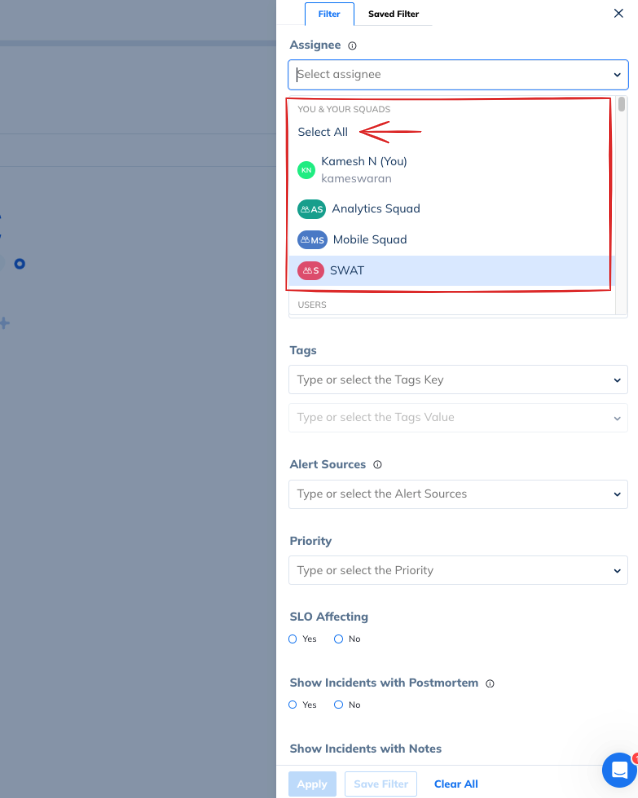
### Incidents assigned to you or your squads:

* Your squads are shown at the top of the Assignee dropdown
* You can click on 'select all' to view incidents assigned to you or your squads

<figure><img src="https://1574591692-files.gitbook.io/~/files/v0/b/gitbook-x-prod.appspot.com/o/spaces%2F8TaWz01jmUJl58p4ZVel%2Fuploads%2Fgit-blob-fdb20ac011cdc256820dbc1f2b9b22ab793b24bf%2FScreenshot%202024-07-09%20at%202.10.49%E2%80%AFPM.png?alt=media" alt=""><figcaption></figcaption></figure>

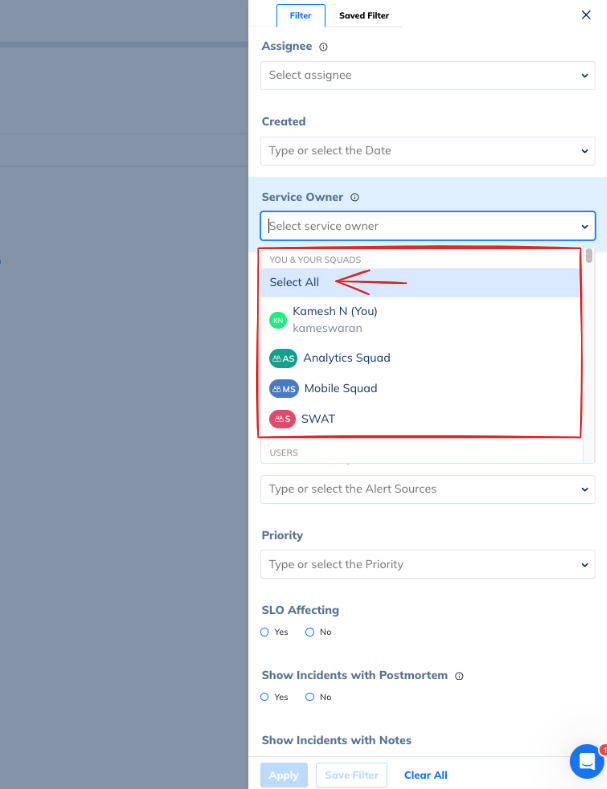
### Incidents that affect services owned by you or your squads:

* Your squads are shown at the top of the Service Owner dropdown
* You can click on 'select all' to view incidents that affect services owned by your or your squads

<figure><img src="https://1574591692-files.gitbook.io/~/files/v0/b/gitbook-x-prod.appspot.com/o/spaces%2F8TaWz01jmUJl58p4ZVel%2Fuploads%2Fgit-blob-f3bcf2e482e163cc79a0943be87c673fd24792f4%2FScreenshot%202024-07-09%20at%202.14.40%E2%80%AFPM.png?alt=media" alt=""><figcaption></figcaption></figure>

*Have any questions?* [*Ask the community*](https://community.squadcast.com/view/home)*.*


---

# Agent Instructions: Querying This Documentation

If you need additional information that is not directly available in this page, you can query the documentation dynamically by asking a question.

Perform an HTTP GET request on the current page URL with the `ask` query parameter:

```
GET https://support.squadcast.com/incident-list/filter-incidents.md?ask=<question>
```

The question should be specific, self-contained, and written in natural language.
The response will contain a direct answer to the question and relevant excerpts and sources from the documentation.

Use this mechanism when the answer is not explicitly present in the current page, you need clarification or additional context, or you want to retrieve related documentation sections.